
On Colouring Pencils
For a few years now, I’ve been considering colouring pencils for making artworks, though there tends to be something holding me back from using them when it comes to putting thoughts down.
Part of me wonders whether this is to do with an unspoken yet still received prejudice against colouring pencils; perhaps they are seen as somewhat unsophisticated, simple, childish. It’s interesting to me that colouring pencils have been a mainstay of almost everyone’s artistic path since they were very young, though at some point, they get forgotten. Having done some research into quality pencils lately, and having embarked on a daily drawing challenge, my love for them has been reawakened, so much so that I decided to write about them!
A (Very) Brief History Colouring Pencils
According to Wikipedia, crayons have been used since the Greek Golden Age, and they were also documented by a Roman scholar, Pliny the Elder. Wax-like materials were a good choice for artists due to their resistance to decay, the vividness and brilliance of their colours, and their unique rendering qualities; I would also add that there is a level of control and precision that they offer that is not necessarily the case with more liquid mediums. Later, coloured pencils were used mostly for checking and marking, and it was only in the early 20th century that artist-grade colouring pencils were produced. The German family-owned brand Faber-Castell began producing coloured pencils in 1908, followed by Caran d’Ache in 1924 and later Berol Prismacolor in 1938. It’s interesting to note that all of the above listed companies are still producing extremely high-quality coloured pencils…
Last month at my local drawing classes, there was a workshop hosted by Patrick Byrnes (an incredible artist, have a look at his work here) where he taught the Trois Crayons technique. This was a style of drawing that had its roots in the second half of the 15th century in Europe, and developed across Italy and France with the use of red and white chalk on white paper or parchment. In the 17th century, the technique developed further, combining red, white and black chalk to produce aux trois crayons technique, typically drawn on blue or tan coloured paper. The technique was then popularised in the 18th century and was used by artists such as Watteau, Boucher and Rubens, producing vivid and energetic artworks that set the tone for Rococo aesthetics.
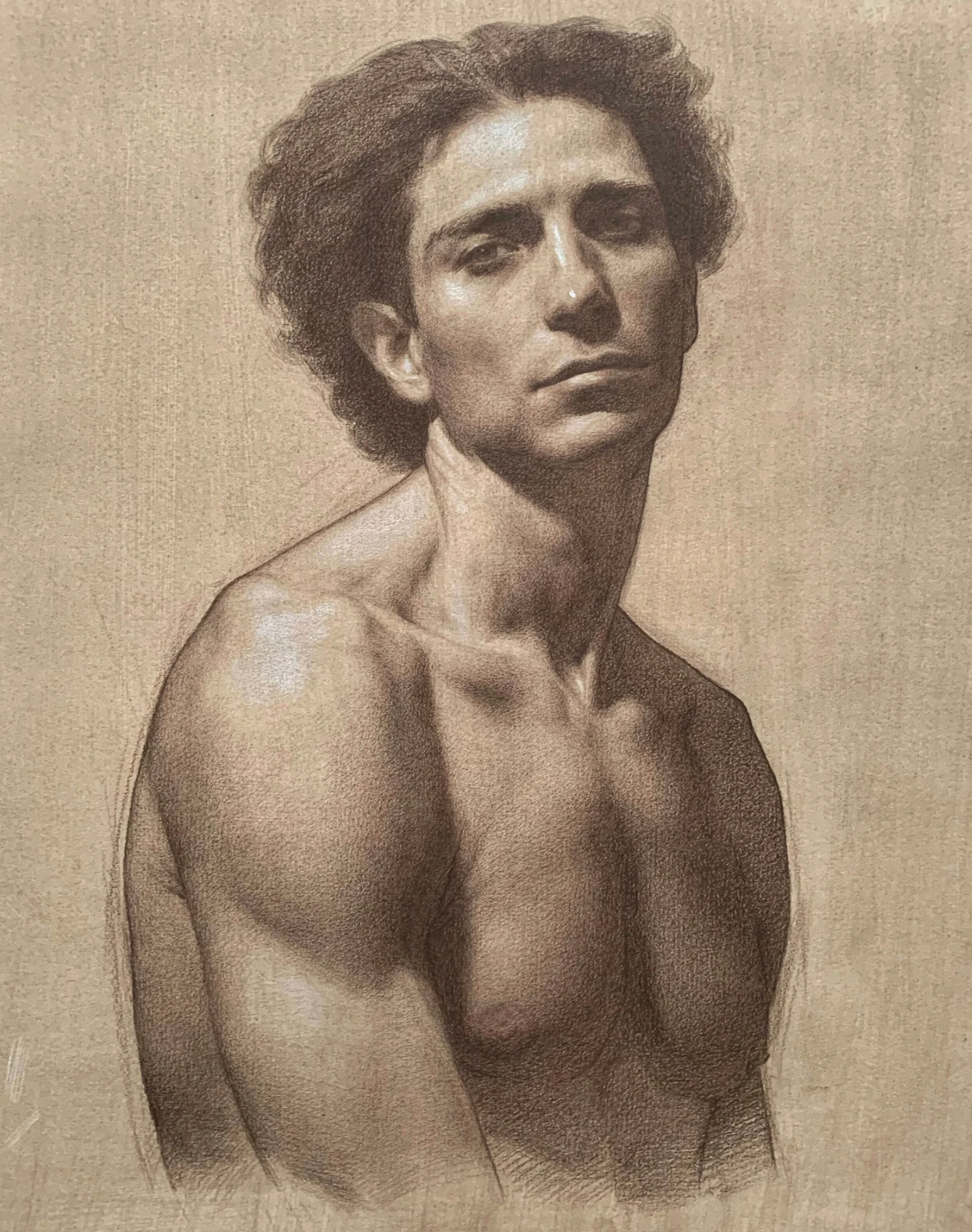
Drawing by Patrick Byrnes using the Trois Crayons technique. Full drawing is here and it’s beautiful!
More Than Trois Crayons
While I find a lot of the aux trois crayons drawings delicate and beautiful, part of me wonders whether they are somewhat lifeless. Also, to me there’s something a little bit limiting about recreating the look and feel of artworks that are so closely associated with a particular time in art history, when the materials, techniques and knowledge available to us are now so much more complex. What is an artist saying when they draw using the trois crayons style? Are they harking back to what is perceived to be a more sophisticated way of seeing the world? Or perhaps the imposition of a limit of colour allows the artist to focus on other things that they might consider more important, such as composition, form and value.
Many classical drawing schools and academies impose a deliberate limitation of materials for this very reason, to be laser-focussed on form, value, proportion, composition. Yet the move into the world of colour jumps often directly into paint. When experimenting with colouring pencils recently, I’ve found it fascinating to introduce colour rendering in many different shades alongside the considerations for density, value, form and composition that one usually associates with graphite – yet achieving the correct colour takes a lot longer. This to me also adds to the joy of the medium, discovering the combinations and layering techniques that help achieve a subtle yet sophisticated artwork.
Daddi Salvatore
I follow many artists on Instagram, and very few of them use colouring pencils. Perhaps because their use is so rare is why the work of the Italian Daddi Salvatore (or maybe his name is Salvatore Daddi?!) has stood out to me. He consistently posts artworks that I find have as a legacy the trois crayons technique (he almost always uses blue or tan paper) yet the colours he uses are vivid, bold, deep and full of life. He almost exclusively draws men in various states of undress, sometimes in provocative or suggestive poses; the use of carefully rendered forms give each of the artworks a really sensitive and gentle quality. On a more abstract note, there’s something sensual about the very tactile process of a pencil stroking the grain of paper to render an observed human form. I’m a big fan of this work, and I seek to give my own works this kind of vibrancy.
Colouring Pencils and Me
When I was getting into art more seriously as a teenager, I was gifted a metal box of Caran D’Ache colouring pencils, that I absolutely loved. I used them whenever I could, almost daily, mostly for homework, as the box and the pencils themselves were too precious to get thrown about in a school backpack, or, horror-of-horrors, lost, damaged or stolen. Some of them I used down to little nibs. I took this box with me to university, thinking they’d be useful in architecture school; I remember using them for exactly one drawing. This was a time when CAD designs and digital rendering programmes were coming into their own and being popularised; anything hand-drawn was considered twee, old-fashioned, passé. It’s only really been in the last couple of years, as I’ve reacquainted myself with hand-drawing and observational, figurative art, that I’ve been curious enough to explore those initial experiences that drew me to art in the first place.
So last week I gifted myself with another metal box of colouring pencils, 120 this time (Polychromos from Faber-Castell if you’re curious!). The joy I get from seeing them, from smelling them, from their waxy and vibrant colours, is immense. I’ve only done two little drawings with them, two portrait studies on paper, but already I am thinking about using them all the time. I’m loving this rediscovery of mediums, which is informing my rediscovery of why art matters to me.
A selection of some of the incredible drawings by artist Daddi Salvatore from his Instagram page.